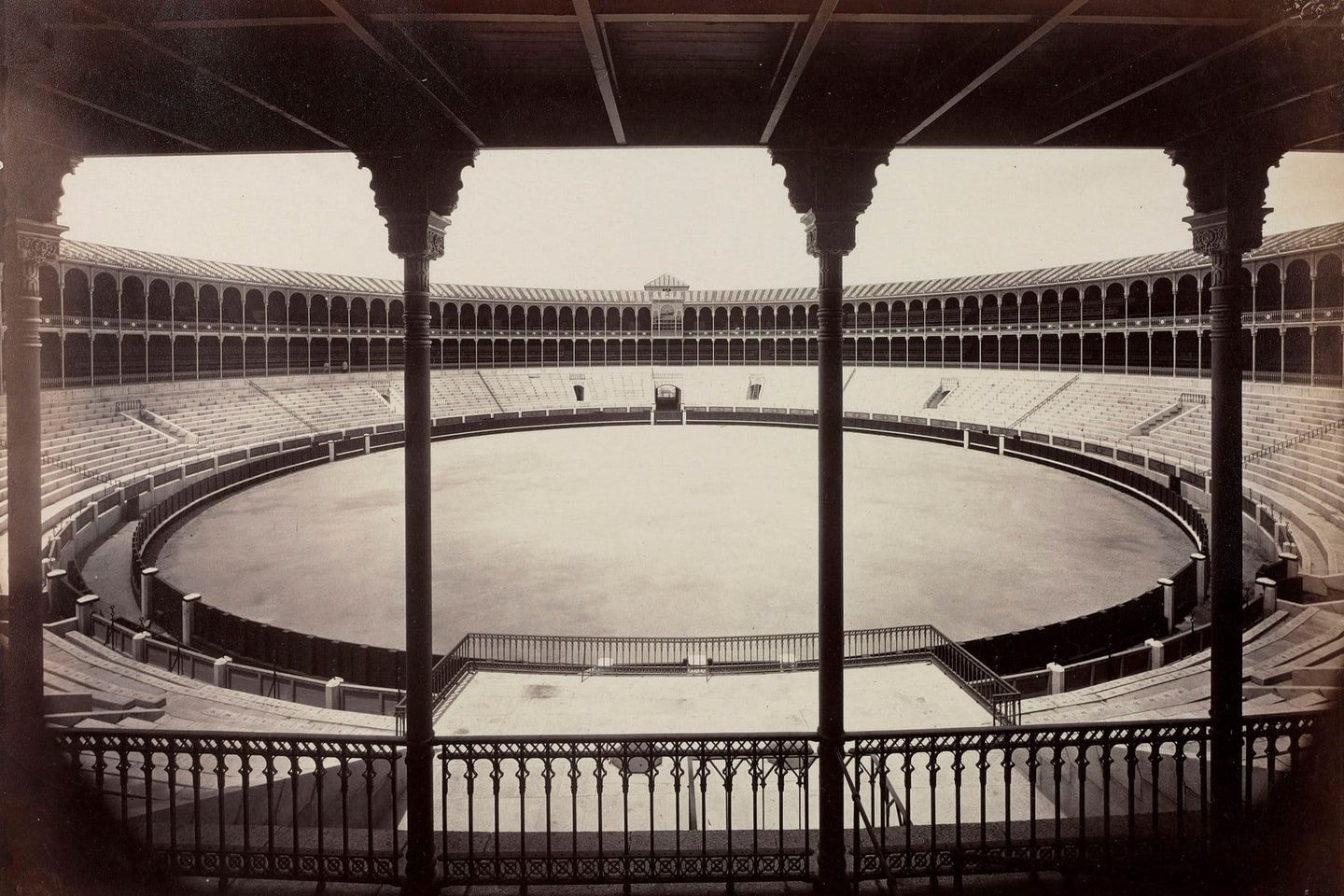
There is a moment, a few days before a feria begins, when nothing has happened yet and, nevertheless, everything is already there.
The bills have been made public. The names are set in black on white. The combinations, decided. Time —that time so particular to the ring— has not yet begun to run, but it has already taken on a form.
This space is born precisely in that interval.
Not as a place of information, nor as a commentary tracking the bullfighting news, but as an attempt to think bullfighting from another place: not so much from what happens as from how it happens. From the forms, the gestures, the times that make it possible for something to occur in the ring.
My name is Antonio J. Pradel. I have spent years writing about bullfighting, bulls and bullfighters. Not so much to explain what happens in a corrida as to try to understand what exactly we see when we watch a bullfight.
This notebook —for that is what it aspires to be— stands in that line.
There will be no chronicles in the usual sense here, nor instant verdicts. Nor defence or refutation in the habitual sense. There will be, rather, a series of approaches: short, self-contained texts that take a specific aspect of bullfighting —the gesture, the stillness, the distance, fear— and unfold it as a problem.
And yet, this first issue cannot avoid an unavoidable circumstance: the imminence of the coming Feria de San Isidro.
Looking at a feria
A feria is not simply a sum of corridas more or less attractive on paper.
It is a structure.
A system of repetitions and variations in which, for a few weeks, the same elements —bulls, bullfighters, public— are reorganised again and again, producing, at times, something unexpected.
In that sense, the bills are not only a programme: they are a hypothesis. They propose what might happen. But what is interesting is not in confirming those expectations, but in observing how they deviate.
Each evening introduces a minimal variation: a bullfighter who arrives at a different moment than expected; a breeding-ranch that responds in an unforeseen way; a public that shifts its temperature on a whim…
And in that play of differences, everything is decided.
The bull
There is, however, something that, beyond the ranch announced each evening, cannot be wholly guessed from the bills and that, nevertheless, conditions absolutely everything.
The bull.
People speak of names, of trajectories, of moments. Combinations are analysed. Expectations are projected. But that whole system —always in precarious balance— depends on something that does not belong to that order.
The bull is not just one more variable.
It is, precisely, what prevents the corrida from becoming a mechanism or, worse still, an ordinary spectacle.
Each bull introduces a radical difference. Not a variation within a scheme established in advance, but an interruption. Its behaviour cannot be wholly deduced: not from the ranch, nor from the bloodline, nor from the statistics. There always remains a remainder. That unforeseeable remainder is the crux of the matter.
And it is there that the corrida really begins.
The bullfighter does not face an idea of the bull, but its absolute presence. And that presence —physical, concrete, fascinating, irreducible— forces everything to be adjusted: the place, the time, the gesture.
Before being an art of domination, bullfighting is an art of response. Of how to respond to what one will never wholly come to know.
The names and time
In the San Isidro bills —as in almost every feria— several times coexist at once.
There are bullfighters settled into a recognisable form, one might almost say a stable one. Those whose bullfighting consists, to a great extent, in reproducing with precision an idea already conquered.
And there are the others: those who fight at the limit of that form, those who introduce an instability, a misalignment, a crack.
It is not a matter here of establishing a hierarchy.
It is a matter of understanding that each one proposes a different relation with time: while some fix it, others open it. And that, in the tension between those two positions, the very possibility of the feria is at stake.
What is not on the bills
But the decisive thing —as almost always— is not written down.
It is not in the names nor in the dates.
It is in something far harder to foresee: in whether, at some point, during some evening, there occurs what we might call an apparition.
An instant in which the gesture ceases to be execution and becomes form. A moment in which time seems to stop —not because nothing happens, but because everything happens in an unforeseen way.
That cannot be programmed.
And yet, it is the only thing that matters. The only thing that will remain fixed in the aficionado's memory.
From here…
This logbook begins there: in that margin between the foreseen and what has not yet happened.
In coming issues we will pause on some of the elements that make that kind of apparition possible:
stillness, the sitio, distance, fear, the gesture…
Not as themes, but as problems.
Because perhaps bullfighting is not so much an art of doing things in front of a brave bull as an art of how and when to do them.