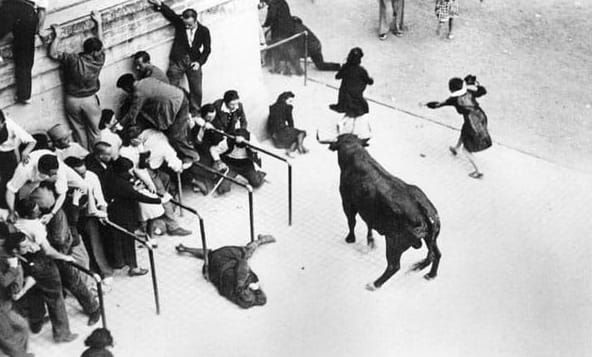
In 1939 a Sánchez Cobaleda bull named Liebrero broke through the fencing of the Pamplona encierro and spread panic beside the bullring's ticket booths. The photograph of that instant has become part of the memory of San Fermín. In it we do not see merely an accident. We see a rite breaking apart. As long as the bull stayed inside the course, the danger was part of an order everyone accepted. Once it crossed the fencing, all that remained was a loose bull and a crowd fleeing for their lives.
That morning the city understood that even a fiesta needs a form. And a limit.
Festivals rarely disappear all at once. More often they are slowly emptied of meaning. They keep their routes, their symbols and their ceremonies, but they forget what had kept them alive. The forms remain. Their reason for being fades away.
Several decades ago, Santiago Amón warned that the true danger to bullfighting was not only the hostility of its adversaries. The deeper risk lay elsewhere: in our ceasing to understand what a fiesta means. Seen from today, that intuition feels more current than ever.
Because a fiesta is not simply a matter of gathering or having fun. It interrupts ordinary time in order to celebrate what a community considers worthy of celebration. It has a centre. As long as that centre holds, the fiesta keeps its truth. When it disappears, the celebration may carry on for a while, but it ends up becoming a spectacle, a custom, or a tourist product.
Perhaps that is why San Fermín remains an exception.
Not because for nine days Pamplona receives visitors from all over the world, nor because the encierro is broadcast live to millions. What is exceptional is that the bull still organises the city's time. It sets the hours. It gathers the runners at dawn and the aficionados in the afternoon. It gives meaning to the route through the streets and to the silence of the corrals.
The fiesta begins long before the chupinazo.
It begins at the Corrales del Gas.
In these days thousands of people file past the bulls that will run the encierro and be fought in the afternoon. They expect nothing extraordinary to happen. They look. They compare. They comment in low voices on the seriousness of a head, the set of a pair of horns, the harmony of a well-made, well-finished animal. Children ask questions. Their elders answer by pointing to a particular animal. The fiesta has not yet officially begun and yet it is already happening.
Among them this year one stands out: a light cárdeno from Cebada Gago named Filósofo. While many search for the names of the bullfighters, others linger a while before the bull. Before it ever charges, the bull demands something unusual in our time: to be contemplated and admired for the fascination it stirs.
This is no minor detail.
It says a great deal about the nature of San Fermín.
One need only look over this year's bills to understand it. Cebada Gago, José Escolar and Miura hold a natural place in the fair because they embody a certain idea of the bull: a whole animal, unpredictable, still the owner of an irreducible character. Alongside them appear other ganaderías and other conceptions of bullfighting, such as Morante's with the bulls of Álvaro Núñez. Diversity does not weaken the fair. It strengthens it. Because every sensibility finds its place, so long as the true protagonist remains the same.
Here too, however, certain changes are beginning to be felt.
Television has made the encierro known throughout the world. But every image ends up shaping, in one way or another, the very thing it shows. Each year it becomes more common to find runners whose main concern seems to be staying a few seconds longer in front of the camera. They do not run only in front of the bull; they run in front of the lens as well.
There is a profound difference between living a fiesta and needing to watch oneself living it.
Something similar happens when, in certain circles, the proposal resurfaces to keep the encierros while doing away with the bullfights. Its defenders believe they are thus protecting the most popular and international part of San Fermín. Yet the problem is neither historical nor a matter of identity. It is, above all, a question of meaning.
The encierro is not simply about running in front of some bulls.
It is about leading them to the ring.
All the intensity of that run is born precisely from its destination. The movement has a direction. If that direction disappears, the run remains, but its meaning changes radically.
It is true of every rite. A procession is not a collective stroll. A pilgrimage is not merely walking. In the same way, an encierro is not a mass sprint around some bulls. When a rite loses its purpose it may keep its appearance intact, but it ceases to be the same rite.
Perhaps that is why the image of a few aficionados going to see the bulls in the corrals is still so moving. There, as yet, there is no spectacle. No cameras hunting for the best shot. Only a handful of people contemplating the true protagonist of the fiesta.
As long as the bull goes on occupying that place, San Fermín will keep its meaning.
The day the bull ceases to be the centre and the fiesta begins to be celebrated around its own image, the peñas will still sing, the streets will still fill, and the young men and the wine will still run. But the old fencing that once separated the rite from chaos will have begun, silently, to move somewhere else.